
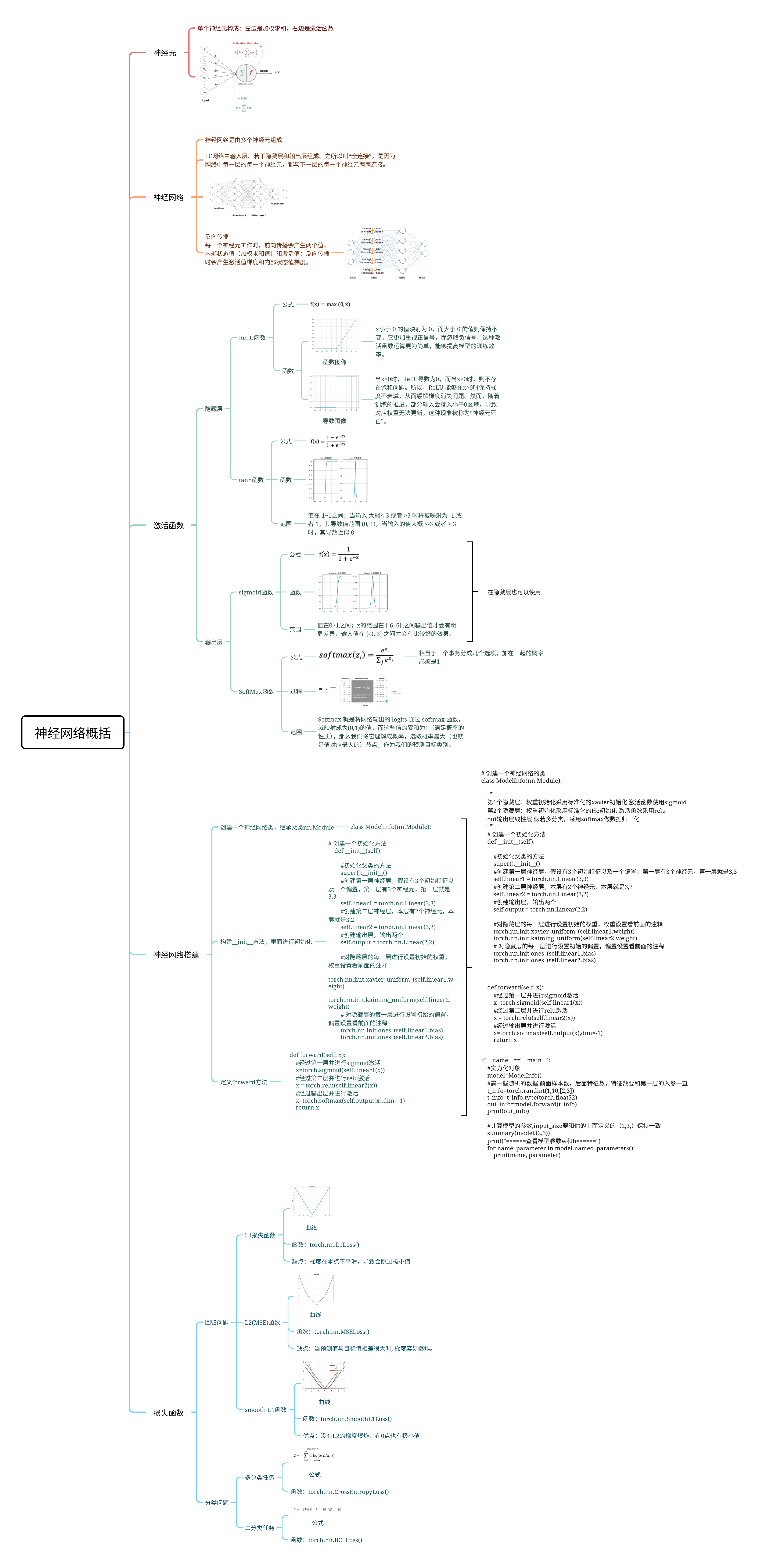
神经网络概览
人工神经网络
人工神经网络:输入层 | 隐藏层 | 输出层
全连接层 = 每一个神经元都是和上一层的所有神经元相连接,每一层的神经元互不连接
神经元(加权求和|激活函数)
加权求和 - 线性转换
激活函数(4) - 非线性因素
使用场景:
隐藏层(激活函数: ReLU 、tanh ) 输出层(激活函数:Sigmoid、Softmax)
sigmoid 值域 0~1 有效定义域 -6,6 高效定义域-3,3
sigmoid 导函数值域 0~0.25
激活函数
隐藏层(导函数):
ReLU : 0~1
tanh : 0~1
输出层(原函数):
sigmoid : 0~1
softmax : 将内容转换为概率
搭建神经网络(掌握)
1.定义一个类,继承nn.Module
class Model(nn.Module):
2.重写__init__方法 - 定义层
def init():
2.0 - 调用父类初始化方法
super().init()
2.1 - 搭建神经网络层
self.fc1 = torch.nn.Linear(上一层输出的数量x1,当前层的神经元数量x2) #x1表示特征有多少
self.fc2 = torch.nn.Linear(上一层输出的数量x2,当前层的神经元数量x3)
self.out = torch.nn.Linear(上一层输出的数量x3,当前层的神经元数量x4) #x4表示标签有多少
2.2 - 定义每层的权重
torch.nn.init.kaiming_normal(self.fc1.weight)
torch.nn.init.kaiming_normal(self.fc2.weight)
2.3 - 定义每层的偏置
torch.nn.init.ones(self.fc1.bias)
torch.nn.init.ones(self.fc2.bias)
3.定义一个forward方法 - 定义激活函数
def forward(self,x):
x1 = torch.relu(self.fc1(x))
x2 = torch.relu(self.fc2(x1))
result = torch.sigmoid(self.out(x2))
return result
初始化参数:
1.全0 - torch.nn.init.zeros()
2.全1 - torch.nn.init.ones()
3.指定 - torch.nn.init.constant(权重,0.123)
4.随机 - torch.nn.init.uniform()
5.正态 - torch.nn.init.normal()
6.凯明(只关心输入) - torch.nn.init.kaiming_normal() / torch.nn.init.kaiming_uniform()
7.泽维尔(关心输入输出) - torch.nn.init.xavier_normal() / torch.nn.init.xavier_uniform()
损失函数
衡量真实值与预测值之间误差的函数
回归问题:
L1Loss
MSELoss
SmoothL1Loss
分类问题:
BCELoss
CrossEntropyLoss